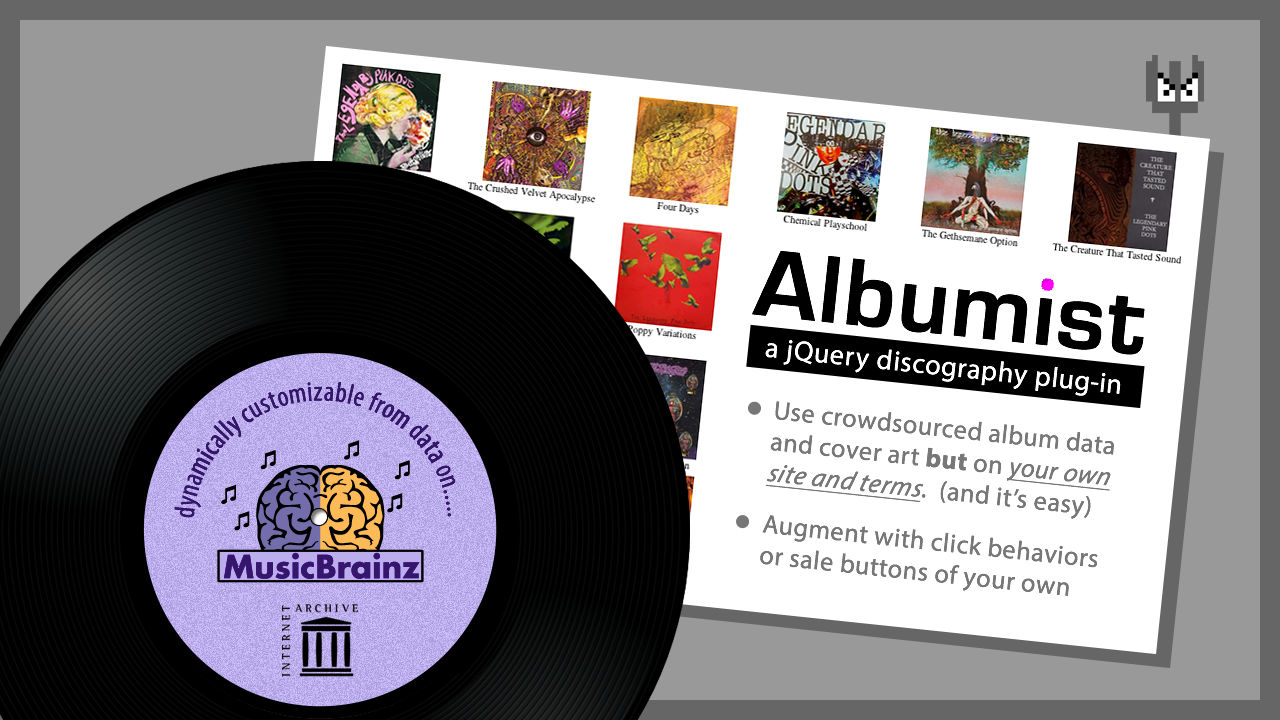
Albumist is an open source jQuery plug-in, which lets you make a discography widget from cover art available through MusicBrainz and the Internet Archive. It currently combines that with track listing information in Freebase, which mirrors and synchronizes with MusicBrainz.
The idea was to give bands an easy way to offer an interactive discography on their own websites or blogs, without requiring them to maintain and curate a database. It also allows for customization of the presentation--for instance adding "Buy Now" links.
UPDATE 30-Jun-2015
Google has sadly discontinued the Freebase API, and new webmasters have changed the Legendary Pink Dots website to a new stack. See the YouTube demo video for how it used to look and work. If someone were interested in doing something similar with jQuery against some replacement API for Freebase, the code on GitHub may still be a good starting point.
Overview Video
Source
Hopefully more LPD fans, and other bands/fans will be interested in helping develop this. I've released Albumist under the Creative Commons Attribution License 4.0 -- which is the same license Freebase uses for its data. You can download it from GitHub:
Note
Creative Commons is not generally seen as a legally-enforceable license for software. But since Albumist is something to be used by bands, I think the intent is best conveyed using a CC license due to their clear explanations. That's more worth learning than the details of 4-clause vs. 3-clause BSD or trying to gain publicity for the obscure CPAL!
Backstory
In 2008, the band The Legendary Pink Dots chose a new webmaster, to create a new site for their Internet presence. Historically their site had existed as a set of static files on a volunteer's server, who maintained discography information for a number of different artists. The new idea was to actually build something more of an archive and long-term presence under a domain controlled by the band... so legendarypinkdots.org was established.
The new webmaster came to me in confusion over what to do with all these previous static files (that were non-database-driven PHP). She didn't know how to do it, but wanted to make a visual discography you could explore on the site. The best solution to me seemed to be to shift the focus from trying to do anything with that PHP or define another format, but rather to leverage the existing work being done by MusicBrainz and Freebase. A small JavaScript codebase could then assemble the information, and even alter it before presenting it on the site.
So that webmaster set out to get all the information entered into the databases, while I set out to write Albumist. This was in 2008, and for a Joomla 1.5 installation; which used the standard library MooTools. I hacked it together well enough that it seemed to work in most browsers, and the Legendary Pink Dots site had a pretty nice discography.
Once the initial site launch was complete, I didn't really keep up with it. But in 2013 was contacted due to a change of the reigns for the website by yet another new administrator. The discography was having problems in modern browsers and there had been breaking API changes in the intervening years, but she wanted to get it working again. Looking into the issues - I found that the interface that I had been using to get the album covers was no longer allowing new uploads, due to legal concerns about copyrighted images.
Fortunately MusicBrainz and the Internet Archive had begun an effort to create the Cover Art Archive. So it was a matter of bringing that up to date. Yet it was also the case that no one was using mootools any longer, and as long as I was looking at the problem I might as well bring it up to date as a jQuery plug-in and obey the conventions that people now take for granted.
Having gotten a fair bit of experience writing jQuery plugins with Blackhighlighter, it wasn't all that difficult to bite the bullet and do a conversion. I took the opportunity to fix several other stylistic things. There's much that could be improved, but I can say that it's probably on the right track for 2014 methods for something like this.
Philosophy
I wasn't really familiar with The Legendary Pink Dots' body of work before getting involved with the project. So to get involved initially, I focused on a couple of issues I felt strongly about. Myspace was already on the wane, and the short-term convenience of establishing a third-party service as one's presence seemed to be a proven bad move. Repeating the mistake with Facebook didn't seem like a good idea, nor did being hosted at
http://someguyswebsite.com/legendarypinkdots seem good either.Note
By the same token, I'll argue against the domain name mafia, who bleed you for money every month to "own a name". Instead it should give everyone their own number, and then letting software negotiate who in a given peer network gets the unqualified name based on trust. But that's a discussion for another blog.
But making one's own site, where one shows one's own ads (if one wants ads at all), was getting easier. And I felt there was a balance that could be struck between using public information and being able to customize the experience on one's website. Albumist was a thought-experiment in that vein. I think open source offers many of these opportunities where you can keep creative control of the experience at point of delivery, while still keeping your identity as that point if the services you use let you down.
LyricWiki Replacement Needed
Speaking of services letting you down: as a Wikipedia-believer, I may read a bit too much into the word "Wiki". So I was rather outraged in a change that happened with a site called LyricWiki that Albumist initially built on.
In 2008, you could use an API to access lyrics for songs on LyricWiki, and you could drive people to their website to enter lyrics. I dealt with their somewhat clunky API to try and integrate it, and got it working well enough for the purposes. Other users (and myself) visited the site to type in lyrics for popular albums.
The site pulled this API due to "pressure from music labels". But these labels were somehow "willing to grant" LyricWiki the ability to excerpt lyrics from songs, in return advertising or somesuch once people land on the LyricWiki site.
Excuse me: How exactly is it that "music labels" are able to declare their rights on independent artists, with whom they have no relationship, and whom they cannot speak for?
It's one thing if some people gave up their rights to a label, and now find themselves in a legal mire for that misstep due to not believing in independence in the first place. That's a teachable moment--one the future will hopefully learn from instead of repeat. It's quite another thing when artists with no arrangements with said labels are bearing limitations due to of what others have signed. Further, shouldn't the independent artists be getting a "piece of the pie" if their lyrics are on the site?
So if you're an independent artist with any lyrics present on LyricWiki, I encourage you to immediately write a cease and desist letter to them for making this deal on your behalf. Make them take your lyrics down: don't let the labels you didn't sign with get away with a phony bulk deal.
That's my call to action. Note that projects like the non-profit MusicBrainz emerged from people standing up to an unethical company (GraceNote/CDDB) that relied on volunteer contributions to build a music database. After taking this volunteer effort to give them their value, they turned around claiming they owned that system and demanding software projects pay royalties to use it.
Don't forget that your voice counts! Being on the right side of history is its own reward! (And who knows, maybe there are other rewards?)
Origins of the Name
In the vernacular, an "albumist" is someone who feels that the medium of the album as a collection of songs--arranged in order to be experienced start to finish--is an important art form. This would stand in contrast to a "songist", who believes that the ideal distribution unit is single songs.
An "extreme songist" might say that the only reason albums existed in the past was because it simply wasn't feasible (in economics or distribution) for an artist to release and distribute one song at a time. Therefore, digital distribution methods will make albums irrelevant: an artist could even release one song at a time on Twitter, whenever each was finished. An albumist would counter that there is something natural about the musical creation process needing a framework of a larger grouping unit.
I'm not sure I have drawn any conclusions. There have always been "singles", and I've seen instances forcing release of a whole album when there's only one good track that leads to a waste of time and money for artist and listener alike. (I'm looking at you, Gary Clail...$12.99 was a lot of money for me back then.) Yet I'm still biased to seeing albums as a chance for artists to be the DJ of their own work, and carry you along a mood and line of thinking that lasts longer than a TV commercial break.
The Legendary Pink Dots are certainly big on the "concept album", so they are a good band to build a tool like this for. I bought albumist.org and albumist.com with the hopes of perhaps providing a place for discussing the topic, so if you're interested in that let me know.